
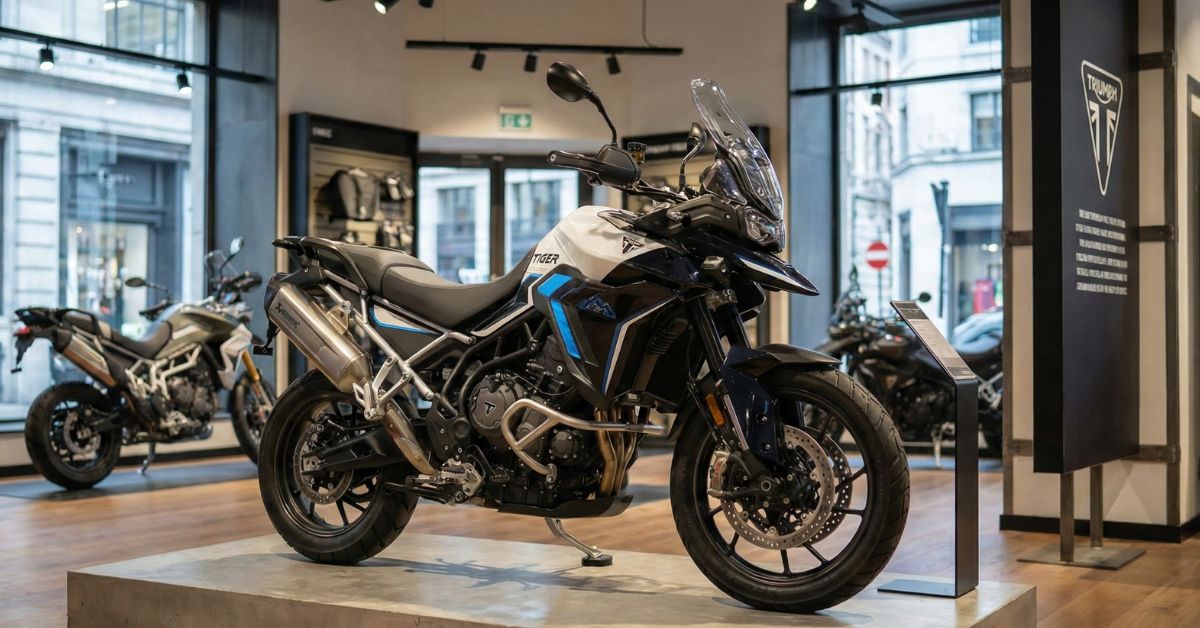
The Triumph Tiger 900 Alpine Edition represents a premium entry point into the middleweight adventure touring segment, positioned for riders who demand versatility without the premium price tag of larger adventure platforms. Triumph, with over 120 years of engineering pedigree, has established itself as a cornerstone manufacturer in the adventure motorcycle category, and the Tiger lineup embodies the brand’s commitment to delivering accessible performance.
The Alpine Edition specifically targets experienced road and leisure off-road riders seeking a machine equally at home navigating urban environments, tackling mountain passes, and exploring light gravel roads.
This 2025 iteration combines a refined 888cc triple-cylinder engine with purposeful design and contemporary technology, delivering competitive power delivery with genuine real-world comfort for long-distance touring. The Alpine’s distinctive white-and-blue paint scheme with protective engineering bars signals its mission: a capable all-rounder that refuses to compromise between on-road responsiveness and adventure-oriented durability.
At its core, the Tiger 900 Alpine Edition answers a specific market demand—riders wanting a middleweight adventure bike that balances cost efficiency with feature richness, suitable for both commuting and multi-week journeys.
Design
The Tiger 900 Alpine Edition stands out through deliberate styling choices that emphasize its adventure-touring purpose while maintaining elegant proportions. Finished in Snowdonia White and Sapphire Black with striking Aegean Blue accents, the bike presents a sophisticated color palette inspired by mountain topography, creating visual differentiation within the middleweight adventure segment. The design grammar includes a purposeful beak, body-colored fuel tank panels, and a raised windscreen offering adjustable positions for varying wind protection and ergonomic preferences. Sapphire Black mudguard supports, radiator covers, and tank end panels ground the design visually while maximizing perceived capability. The inclusion of engine protection bars—exclusive to the Alpine Edition—reflects functional design philosophy, protecting critical components during off-road excursions or accidental lowsides.
The grab rail features matte finishing to reduce glare and visual bulk. Overall proportions remain manageable with a 2,305mm length and 930mm handlebar width, making the Alpine genuinely maneuverable in urban settings despite its adventure-bike architecture. The design language successfully communicates “serious adventure” without appearing overwrought, appealing to riders who view motorcycles as functional tools rather than purely aesthetic statements.
Engine
At the heart of the Alpine Edition beats an 888cc liquid-cooled inline triple engine representing Triumph’s refined approach to middleweight power delivery. Delivering 108 PS at 9,500 rpm and 90 Nm of torque at 6,850 rpm, this three-cylinder powerplant offers distinctive characteristics compared to parallel-twin competitors—notably smoother power distribution and a charismatic exhaust note that many riders find engaging without becoming fatiguing on long rides. The engine features a DOHC 12-valve configuration with 4 valves per cylinder, optimized through higher compression ratios, high-lift cams, and modified intake trumpets that increase power output by 12.5% compared to earlier generations.
Electronic fuel injection with throttle-by-wire management ensures precise fuel metering across all riding conditions. The factory-fitted Akrapovič silencer, included as standard on the Alpine Edition for the first time on any Triumph adventure bike, contributes to both performance and exhaust character. A wet, multi-plate slip-and-assist clutch paired with a 6-speed gearbox provides smooth gear transitions, critical for adventure riders navigating variable terrain throughout extended riding sessions.
Performance
Real-world performance characteristics position the Tiger 900 Alpine as genuinely competent rather than merely adequate. Acceleration from standstill to 100 kmph requires 4.77 seconds, demonstrating brisk urban responsiveness and safe highway merging capability. Roll-on acceleration between 30-70 kmph achieves 2.4 seconds, making overtaking maneuvers feel controlled and confident—particularly relevant for adventure riders frequently navigating two-lane mountain roads. Top speed reaches 202 kmph, sufficient for sustained motorway cruising without demanding extreme throttle positions. Critically, the Alpine delivers this performance while maintaining class-competitive fuel consumption of 4.7 liters per 100 kilometers, translating to approximately 21.27 kmpl under mixed riding conditions. This efficiency delivers approximately 425 kilometers of real-world range from the 20-liter fuel tank, eliminating range anxiety during multi-day touring while reducing mid-journey refueling interruptions. Braking performance through 100-0 kmph requires 44.17 meters, demonstrating controlled, progressive deceleration rather than threshold-dependent stopping. Wind vibration remains minimal throughout the RPM spectrum—characteristic of triple-cylinder engines—contributing to ride quality perceptible during 8-hour+ riding days.
Technology
The Alpine Edition incorporates contemporary electronics that balance sophistication with intuitive operation, avoiding the complexity-versus-functionality trade-off plaguing some adventure platforms. A full-color 7-inch TFT touchscreen serves as the command center, offering clear information hierarchy and customizable display configurations accessible through intuitive menu navigation.
MyTriumph Connectivity system integrates Bluetooth connectivity for call and SMS alert notification, enabling riders to stay informed without distraction or the need for hand operations during riding. GPS-integrated navigation provides turn-by-turn guidance with live map display, eliminating separate GPS device requirements. Five riding modes—Road, Rain, Sport, Off-Road, and Rider Configurable—dynamically adjust engine mapping, traction control intervention, and ABS sensitivity according to surface conditions.
Ride mode adjustment occurs seamlessly via handlebar controls, allowing mode selection without parking or manual manipulation. Cornering ABS prevents wheel lockup during aggressive lean angles, a critical safety feature for riders exploring mountain passes or loose surfaces. Additional electronics include traction control, cruise control for motorway fatigue reduction, tire pressure monitoring with real-time warning systems, and emergency braking warning lights. Two USB-C ports enable smartphone integration and power delivery for charging or accessory operation during long journeys, addressing practical requirements increasingly expected by adventure riders.
Specs
| Specification | Value |
| Engine Type | Liquid-cooled, 12-valve, DOHC, inline 3-cylinder |
| Displacement | 888 cc |
| Bore x Stroke | 78.0 mm x 61.9 mm |
| Compression Ratio | 13.0:1 |
| Maximum Power | 108 PS (106.5 bhp) @ 9,500 rpm |
| Maximum Torque | 90 Nm @ 6,850 rpm |
| Fuel System | Multipoint sequential electronic fuel injection |
| Transmission | 6-speed manual with slip-and-assist clutch |
| Frame | Tubular steel trellis (main) + aluminum subframe (rear) |
| Front Suspension | Marzocchi 45mm upside-down forks, manual rebound/compression adjustment, 180mm travel |
| Rear Suspension | Marzocchi unit, electronically adjustable preload/rebound damping, 170mm travel |
| Front Brakes | Twin 320mm floating discs, Brembo Stylema 4-piston monobloc calipers |
| Rear Brakes | Single 255mm disc, single-piston sliding caliper |
| ABS Type | Optimized cornering ABS (dual-channel) |
| Front Tires | Metzeler Tourance Next, 100/90-19 |
| Rear Tires | Metzeler Tourance Next, 150/70R17 |
| Fuel Tank Capacity | 20 liters |
| Seat Height | 820-840 mm (adjustable) |
| Overall Length | 2,305 mm |
| Overall Width | 930 mm (handlebars) |
| Overall Height | 1,410 mm (low screen), 1,460 mm (high screen) |
| Wheelbase | 1,556 mm |
| Steering Rake/Trail | 24.6° / 102.7 mm |
| Kerb Weight | 224 kg |
| ARAI Mileage | 21.27 kmpl |
| Service Interval | 6,000 miles (10,000 km) or 12 months, whichever comes first |
| Warranty | 2 years, unlimited mileage |
| Emissions | EURO 5+ (108 g/km CO2) |
The specifications reveal engineering balance rather than pursuit of extremes. The Marzocchi suspension components offer manual adjustability, permitting rider customization for touring loads or terrain preferences without requiring dealer intervention. Tire selection—Metzeler Tourance Next—reflects touring-focused priorities over extreme off-road grip, delivering durability and predictability for riders frequently transitioning between surfaces. At 224 kg (dry weight), the Alpine remains genuinely manageable for long-distance riders, avoiding the excessive mass that contributes to rider fatigue during multi-hour sessions. The 13.0:1 compression ratio represents optimization for premium fuel, maximizing power output while remaining compatible with standard pump gasoline across most markets.
Dashboard Console
The 7-inch TFT instrument cluster serves as the Alpine’s information hub, presenting data with clarity and customization depth rarely available at this price point. Full-color graphics render maps, telemetry, and riding information with excellent sunlight legibility, addressing a critical weakness of some competitor systems that become illegible during daylight hours. The display presents three customizable information pages—each assignable by the rider through the setup menu—enabling rapid access to personally-relevant data without extensive scrolling. The home screen intuitively displays current speed, gear position, engine RPM, fuel reserve, and temperature information. Navigating menus via the dedicated rocker switch on the left handlebar requires minimal cognitive load while riding, accessible without removing hands from controls. The TFT screen interfaces with the MyTriumph Connectivity system, displaying incoming call notifications, SMS previews, and turn-by-turn navigation instructions with sufficient graphic clarity to enable glance-based navigation confirmation. Adjusting riding modes, suspension preload, and throttle response mapping occurs through this interface, allowing riders to optimize the machine to specific conditions mid-journey. The display supports integration with Triumph’s mobile app, enabling pre-ride route planning and post-ride data analysis. Despite this sophistication, the interface avoids the menu-depth complexity that characterizes some competitor offerings, prioritizing intuitive operation.
Rear View
From the rear, the Alpine Edition presents purposeful, uncluttered visual language while effectively managing functionality. The LED tail light combines brake light and turn signal functions in a compact, modern unit visible from significant distances, addressing visibility criticities that influence touring safety during low-visibility conditions. The rear fender design integrates practical mud-deflection geometry without generating visual bulk. The matte Phantom Black grab rail extends horizontally from the rear subframe, providing passenger grip points while avoiding visual distraction through color-coordination with other trim elements. The Aegean Blue rear radiator cover—a distinctive Alpine feature—creates a subtle focal point without overwhelming the overall design. The swingarm, constructed from twin-sided cast aluminum, maintains visual weight below the wheelbase, contributing to proportioned aesthetics while delivering the rigidity required for off-road impacts. The thin, high-mounted exhaust outlet from the Akrapovič silencer remains relatively inconspicuous from the rear perspective, contrasting with some competitor designs that feature prominent, visually-dominant exhaust elements. The relatively compact dimensions—a narrower profile than several competitors—enhance maneuverability perception and facilitate parking in constrained environments or tight offroad campsites where multiple riders gather. The integration of license plate mounting with lean-angle consideration demonstrates engineering attention to real-world adventure scenarios.
Fuel Tank
The 20-liter fuel tank represents the Alpine’s touring-oriented strategic choice, balancing capacity against weight and center-of-gravity considerations. This capacity delivers approximately 425 kilometers of real-world range, sufficient for full-day riding ventures covering significant geographical distances without obligatory mid-morning refueling interruptions. For multi-day touring, the 425-kilometer range permits efficient fuel-stop planning aligned with meal breaks or landmark visits, avoiding fuel searches as a primary navigation driver. The tank positioning—low and centrally mounted—contributes to the Alpine’s manageable center of gravity, keeping mass concentrated at the chassis’s natural balance point. This design choice translates to improved handling precision and reduced rider fatigue during extended throttle-application scenarios on mountain passages. The Snowdonia White fuel tank integrating Sapphire Black end panels and radiator trim elements creates visual continuity with the overall color strategy. Structurally, the tank utilizes modern fuel-injection-compatible materials that resist permeation and maintain fuel quality throughout extended storage periods, addressing concerns relevant to seasonal riders maintaining motorcycles during off-season months. The fuel filler cap incorporates spring-tension latching, ensuring secure closure while remaining accessible without tool requirements—critical functionality for roadside refueling during unexpected journeys through remote locations. The design successfully conceals the fuel tank’s mass visually, avoiding the bottom-heavy appearance that characterizes some adventure machines.
Headlight
The LED headlight assembly provides contemporary lighting performance essential for adventure riding spanning varied light conditions—from pre-dawn mountain passes to technically-demanding night-riding through unfamiliar terrain. The LED architecture delivers superior light throw compared to conventional halogen technology, illuminating road surfaces at greater distances and with higher intensity, directly influencing rider safety margins during reduced-visibility conditions. The beam pattern combines high and low settings, providing focused illumination for defined directions while avoiding excessive light scatter that creates visibility degradation for oncoming traffic. Daytime Running Lights (DRLs) positioned within the main headlight envelope automatically activate during engine operation, increasing bike visibility to other road users without engaging full-beam illumination—particularly valuable in variable light conditions during early mornings or late afternoons. The headlight housing design integrates seamlessly with the Alpine’s beak design, contributing to the unified visual language rather than appearing appended or secondary. The protective positioning—set behind the beak structure and forward crash protection bars—ensures reasonable durability against off-road branch contact or low-speed impacts during technical terrain navigation. Energy efficiency characteristics of LED technology reduce electrical system loading, translating to reduced drain on the battery during extended low-speed off-road riding where recharging efficiency diminishes. The headlight controls integrate with handlebar switchgear, enabling mode selection without removing hands from controls—a practical detail addressing safety and functionality during challenging riding conditions.
Seat
The seat design addresses one of adventure touring’s critical challenges—delivering comfort during multi-hour riding sessions while maintaining lean-angle definition and ergonomic stability. The single-unit seat design features a stepped profile with graduated firmness—front sections emphasizing feel and feedback while rear sections provide cushioning adequate for pillion passenger comfort during social riding. Seat height adjustment from 820 to 840 millimeters accommodates a broad rider population, from riders near 168 centimeters to those approaching 185 centimeters, addressing a frequently-overlooked consideration affecting adventure bike accessibility. The 840mm raised position improves standing-room ergonomics during technical off-road riding, providing slightly elevated seating that facilitates weight transfer and throttle control during demanding surfaces. Conversely, the 820mm lowered position benefits shorter-statured riders and individuals preferring feet-flat positioning at stops without compromising mid-range riding ergonomics. The fabric covering demonstrates durability against UV degradation and abrasion from rough adventure conditions, resisting premature wear from luggage edge contact or protective gear edge rubbing. Optional heated seat elements—available through Triumph’s accessory catalog—introduce significant touring comfort improvements during cooler-climate riding or seasonal transitions, addressing a frequently-overlooked comfort variable. The pillion seat provides adequate cushioning for occasional passenger carrying, though extended passenger touring on multi-day journeys may benefit from aftermarket seat padding upgrades. Split-seat design permits independent section movement, accommodating luggage mounting or rear-rack accessories without requiring seat removal.
Comparison Table: Triumph Tiger 900 Alpine vs. Leading Competitors
| Specification | Triumph Tiger 900 Alpine | BMW F850 GS | Honda Africa Twin CRF1100L | Suzuki V-Strom 800DE |
| Engine Displacement | 888 cc | 853 cc | 1,084 cc | 776 cc |
| Engine Type | Inline 3-cylinder | Parallel-twin | Parallel-twin | Parallel-twin |
| Maximum Power | 108 PS @ 9,500 rpm | 93 bhp @ 8,250 rpm | 100 bhp @ 7,500 rpm | 84.3 PS @ 8,500 rpm |
| Maximum Torque | 90 Nm @ 6,850 rpm | 92 Nm @ 6,250 rpm | 103-112 Nm @ 6,000 rpm | 78 Nm @ 6,800 rpm |
| ARAI Mileage | 21.27 kmpl | 24 kmpl | 20-24 kmpl | 22.7 kmpl |
| Kerb Weight | 224 kg | 233 kg | 249 kg | 232 kg |
| Fuel Tank Capacity | 20 liters | 15 liters (23L Adventure) | 24.5 liters | 20 liters |
| Front Brakes | Twin 320mm discs, Brembo Stylema | Dual-channel ABS | Twin 320mm discs | Disc |
| Rear Brake | Single 255mm disc | Dual-channel ABS | Single disc | Disc |
| ABS Type | Cornering ABS (dual-channel) | Integral ABS | Cornering ABS | ABS |
| Front Suspension Travel | 180 mm (Marzocchi) | 200-210 mm (BMW) | 200 mm (Showa) | 250 mm (inverted) |
| Rear Suspension Travel | 170 mm (Marzocchi) | 200 mm (BMW) | 200 mm (Showa) | 260 mm |
| Seat Height | 820-840 mm | 850-870 mm | 830-850 mm | 855 mm |
| Top Speed | 202 kmph | 200 kmph | 202 kmph | 205 kmph |
| Warranty | 2 years unlimited mileage | 3 years unlimited mileage | 3 years unlimited mileage | 2 years unlimited mileage |
| Service Interval | 6,000 miles (10,000 km) | 15,000 km | 10,000 km | 12,000 km |
| Base Price (₹) | ₹14,40,000 | ₹12,95,000 | ₹16,02,000 – ₹17,55,000 | ₹11,00,000 |
| Key Differentiator | Akrapovič exhaust, Alpine styling | Shaft drive reliability, German engineering | Larger displacement, more touring-focused | Most affordable, excellent mileage |
Analysis: The Tiger 900 Alpine occupies a compelling middle position—delivering power output competitive with larger-displacement machines while maintaining weight management closer to the lighter category. The Marzocchi suspension tuning prioritizes road comfort over extreme off-road capability, differentiating the Alpine from the Desert Edition’s more aggressive stance. Compared to the BMW F850 GS, the Tiger offers superior power delivery and lower pricing despite similar specs; the Africa Twin commands premium pricing justified by larger displacement and higher perceived touring heritage; the V-Strom 800DE appeals to budget-conscious riders accepting reduced power for superior mileage economics. No single machine dominates across all criteria—selection depends on individual priorities regarding power delivery, suspension philosophy, pricing, and aesthetic preferences.
Frequently Asked Questions
1. What is the real-world fuel mileage of the Tiger 900 Alpine Edition?
The ARAI (Automotive Research Association of India) certified mileage is 21.27 kmpl under standardized test conditions. Real-world mileage varies between 18-24 kmpl depending on riding habits, terrain character, and environmental conditions. Aggressive throttle application and highway riding at maximum-legal-speed limits reduces mileage toward the lower range; smooth acceleration and moderate throttle input increases mileage toward 23+ kmpl. Urban commuting typically achieves 19-21 kmpl due to stop-start dynamics; touring-focused highway riding at steady 100-120 kmph speeds routinely achieves 22-24 kmpl. The 20-liter fuel tank capacity delivers approximately 360-480 kilometers of real-world range depending on riding methodology, permitting full-day riding ventures without mandatory fuel interruptions.
2. Is the Tiger 900 Alpine Edition suitable for daily commuting?
Yes, the Alpine Edition performs adequately for daily commuting despite its adventure-touring positioning. The manageable 224 kg kerb weight and adjustable 820mm seat height accommodate diverse rider populations; the 4.77-second 0-100 kmph acceleration provides safe urban merging capability; the 202 kmph top speed exceeds highway legal limits in most markets. However, commuting reveals trade-offs characteristic of adventure-touring design philosophy—relatively upright seating geometry contributes to slight wind blast at sustained high speeds compared to street-naked machines; suspension tuning prioritizes comfort over sharp road-course feedback; the wide handlebars (930mm) can feel slightly constraining during urban lane filtering maneuvers. Commuters choosing the Alpine gain genuine off-road capability and long-distance comfort should weekend adventures beckon, accepting modest compromises in pure street-riding refinement compared to road-focused sport machines.
3. How comfortable is the Tiger 900 Alpine for long-distance touring?
The Alpine Edition demonstrates strong touring credentials developed through extensive real-world adventure-riding deployment across its Tiger 900 platform heritage. The 820-840mm adjustable seat height addresses diverse rider proportions; the cushioned seat design supports 6-8 hour riding sessions without excessive fatigue when combined with periodic breaks. The windscreen adjusts to two positions, permitting personalized wind deflection optimization. The upright riding position distributes rider mass across seat, handlebars, and foot pegs without concentrating pressure on wrist complexes (a frequent touring complaint). The five riding modes, particularly the Road and Rain modes, optimize traction control and engine responsiveness for extended throttle-application conditions. The 20-liter fuel tank enables 425-kilometer range, facilitating lunch-based fuel stops rather than treating fuel acquisition as a primary routing consideration. Optional heated grips, heated seats, and cruise control significantly enhance multi-hour riding comfort during cooler-season touring. Weight distribution and moderate power delivery reduce fatigue compared to larger, heavier adventure machines requiring greater physical effort during full-day riding.
4. What is the maintenance schedule and typical service costs for the Tiger 900 Alpine?
Triumph specifies service intervals every 6,000 miles (10,000 kilometers) or 12 months, whichever comes first. Initial service (around 600 miles) focuses on component inspection and fluid top-up; subsequent services encompass oil and filter changes, fluid checks (coolant, brake fluid, brake inspection), suspension visual inspection, and chain maintenance. Approximate service costs in North American markets range from $300-500 for basic oil service to $700-1,000 for major services including brake fluid changes and more extensive inspections. Scheduled maintenance proves relatively economical compared to liquid-cooled parallel-twin competitors requiring similar service intervals. The slip-and-assist clutch typically requires no fluid changes, reducing maintenance complexity. Chain and sprocket inspection occurs at each service, with replacement intervals typically exceeding 15,000-20,000 kilometers depending on maintenance discipline. Tire replacement timing depends on riding style and surface exposure; adventure riders on rough surfaces may require replacement every 12,000-15,000 kilometers while road-focused riders may extend intervals to 18,000-20,000 kilometers. Parts availability through Triumph’s global dealer network remains strong, ensuring spare-part accessibility even in remote touring destinations.
5. Should I choose the Tiger 900 Alpine or Desert Edition?
Edition selection depends on touring-versus-adventure-riding balance. The Alpine Edition prioritizes on-road refinement through Marzocchi suspension with 180mm travel and Metzeler Tourance tires optimized for tarmac with light gravel capability. Selection suits riders conducting 70-90% road riding with intermittent gravel exploration. The Desert Edition emphasizes technical off-road capability through Showa suspension with 240mm travel (superior to Alpine’s 180mm), Bridgestone Battlax Adventure tires designed for demanding gravel, and fuel-tank protection bars. Selection suits riders conducting 40-60% gravel riding with technical terrain navigation. Visually, the Alpine presents refined elegance through white and blue color schemes; the Desert communicates rugged capability through grey and orange aesthetics. Pricing typically aligns identically, making selection purely capability and aesthetic-preference driven. For most riders conducting European-style touring with occasional gravel forestry roads, the Alpine Edition satisfies adventure requirements while providing superior on-road manners. Off-road specialists should select the Desert Edition.