
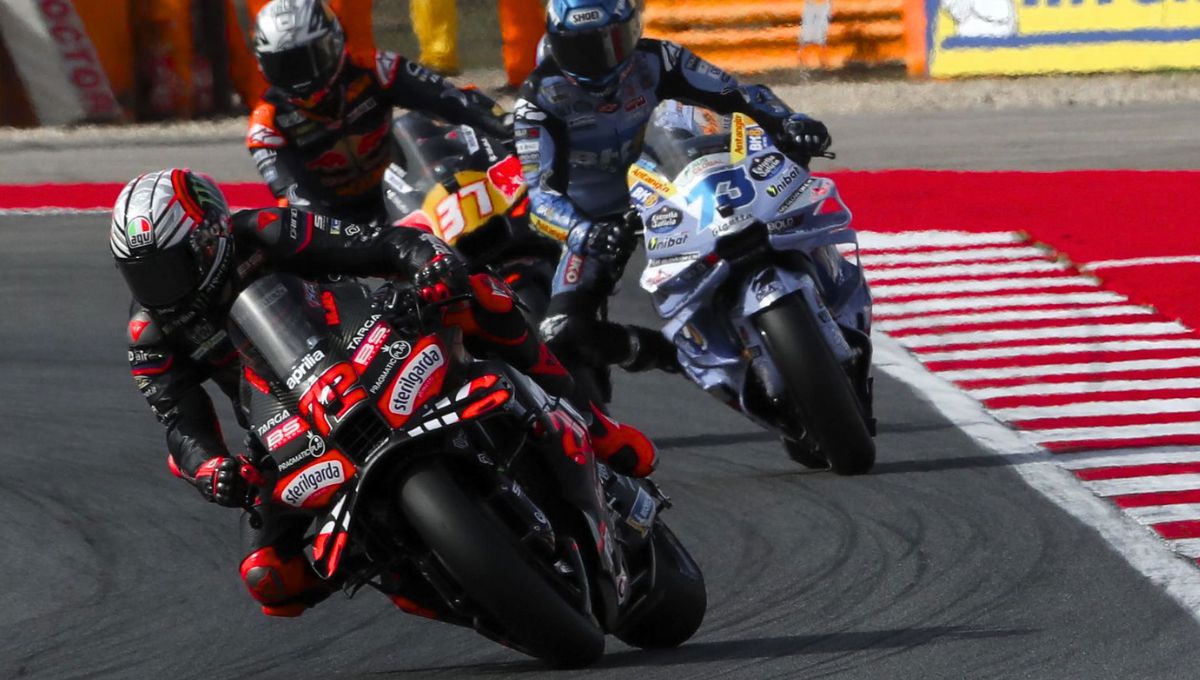
Ducati has spent the last decade redefining success in MotoGP. Its MotoGP bike has been faster, louder, and more technologically aggressive than anything else on the grid. Wins piled up. Championships followed. Rivals scrambled to keep up.
So when Alex Marquez openly acknowledges that Ducati needs to improve its 2026 MotoGP bike, the message cuts through the noise. This is not panic. It is realism.
MotoGP has reached a stage where refinement matters more than domination. Aprilia’s steady gains prove that a smarter motorcycle can challenge a stronger one. Ducati now faces a crucial decision: continue pushing boundaries—or reshape its philosophy.
Alex Marquez emerges as a voice of accountability within a winning system, acknowledging that the future of the Ducati MotoGP bike depends on staying ahead of rapidly evolving rivals.
Rather than suggesting weakness, the title frames Ducati as a team that recognizes success is temporary without constant progress. It taps into the reality of modern MotoGP, where marginal gains, rider confidence, and adaptability define long-term dominance more than past trophies.
Ducati’s Design Philosophy: Power as a Weapon
The Ducati MotoGP bike has historically embraced excess:
- Maximum acceleration
- Aggressive aerodynamic load
- Ultra-rigid chassis geometry
- Explosive launch performance
This approach overwhelmed competitors for years. Ducati bikes controlled race starts, straight-line battles, and late-race sprints.
However, MotoGP is no longer won solely on Sundays. It is won in how a bike behaves on lap 18 with worn tires.
Aprilia’s Counter Philosophy: Control Over Chaos
Aprilia’s rise is not accidental. The brand focused on making its MotoGP bike easier to ride at the limit. Instead of chasing peak figures, Aprilia invested in:
- Predictable power curves
- Neutral corner behavior
- Reduced sensitivity to setup changes
As a result, riders extract consistent performance across varying track conditions. That consistency is now visible in results.
Read more:- Why a Short ChatGPT Outage Caused Big Disruption: And Why It Matters Now?
Alex Marquez’s Insight: A Rider’s Reality Check
Alex Marquez’s comments reflect a rider adapting to a hyper-competitive field. He recognizes that Ducati’s margin for error has shrunk. What once masked weaknesses through brute force now demands precision.
His words highlight a simple truth: when competitors become efficient, inefficiency becomes visible.
Where Ducati’s MotoGP Bike Faces Limitations
Aero Sensitivity
Ducati’s complex aerodynamics deliver downforce but can amplify turbulence effects when following other bikes. Aprilia’s cleaner aero profile appears less sensitive in traffic.
Rider Energy Cost
Riding a Ducati at full attack requires constant physical and mental effort. Over a full race, this can affect consistency.
Narrow Setup Windows
The Ducati MotoGP bike performs best within tight setup margins, leaving less room for adaptability.
2026 Development Pressure: No Room for Mistakes
By 2026, MotoGP manufacturers will face increasing constraints on testing and development. This elevates the importance of baseline design choices.
Ducati cannot rely on rapid iteration alone. It must get the concept right early.
Technical Specs Snapshot: Modern Ducati MotoGP Bike
Engine Architecture
- 1000cc V4 configuration
- Desmodromic valve actuation
- High-revving, torque-rich delivery
Transmission
- Seamless shift gearbox
- Adjustable engine braking systems
Frame & Swingarm
- Aluminum alloy twin-spar frame
- Variable stiffness swingarm designs
Aerodynamics
- Advanced winglet arrays
- Downforce-focused fairing contours
Electronics Suite
- Spec ECU with custom Ducati mapping
- Integrated launch and ride-height control
These specifications remain elite, but competition now matches them with smarter execution.
What “Improvement” Actually Means for Ducati?
Improvement does not mean abandoning speed. It means redefining performance.
Better Load Management
Smoother transitions between braking, turning, and acceleration will preserve tires and reduce rider stress.
Chassis Communication
Improved feedback allows riders to push closer to the limit with confidence.
Aero Efficiency
Reducing drag while maintaining stability could enhance versatility across circuits.
Ducati’s Strategic Strength: Depth Over Dependence
Unlike rivals, Ducati fields multiple competitive bikes. This gives engineers access to vast real-world data. If Ducati listens carefully to rider feedback—including warnings like Marquez’s—it can convert insight into advantage.
The Psychological Shift in MotoGP
MotoGP is entering a maturity phase. Riders value confidence as much as courage. Machines must inspire trust, not intimidation.
Aprilia understands this shift. Ducati must adapt to it.
Why This Moment Matters More Than Results?
Ducati is still winning races. That is precisely why Alex Marquez’s statement matters. Warnings are most valuable before decline, not after it.
MotoGP history shows that manufacturers who evolve proactively stay dominant longer.
Evolution or Erosion
The Ducati MotoGP bike does not need reinvention—it needs refinement. Aprilia’s progress is a reminder that MotoGP rewards intelligence as much as innovation.
Alex Marquez has voiced what many riders quietly feel. The next Ducati must be not just faster, but better.
FAQs
What did Alex Marquez mean by Ducati needing to improve?
He referred to refining rideability, consistency, and efficiency as competitors narrow performance gaps.
Is Aprilia catching Ducati in MotoGP?
Aprilia has significantly reduced the gap through smarter bike behavior rather than raw speed.
What area needs the most improvement on Ducati’s MotoGP bike?
Front-end feel, tire management, and adaptability across circuits.
Does Ducati still have the best MotoGP bike?
In pure performance metrics, yes—but races are increasingly decided by consistency and control.